
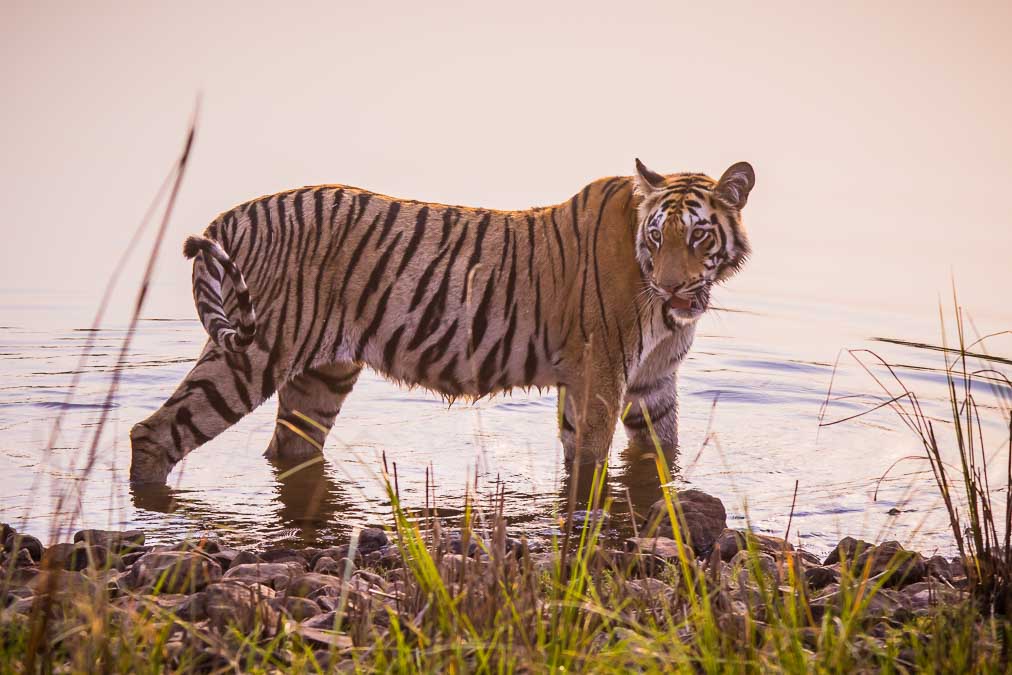
Tigers have been top of my wildlife-to-see list for a while, so that’s what took me to India in April. As usual, I combined the trip with some special sights – and I’m very glad I did.
Varanasi – a Must Visit
First stop was Varanasi – known as India’s spiritual capital. It was one of the most amazing places I’ve ever visited. People flock there to bathe in the Ganges for spiritual liberation and attend evening ceremonies conducted by Brahmin priests. I didn’t do the bathing, but I did attend the evening aarti honouring Mother Ganga. Seven priests performed rituals with chants, incense, lamps and other visual displays.
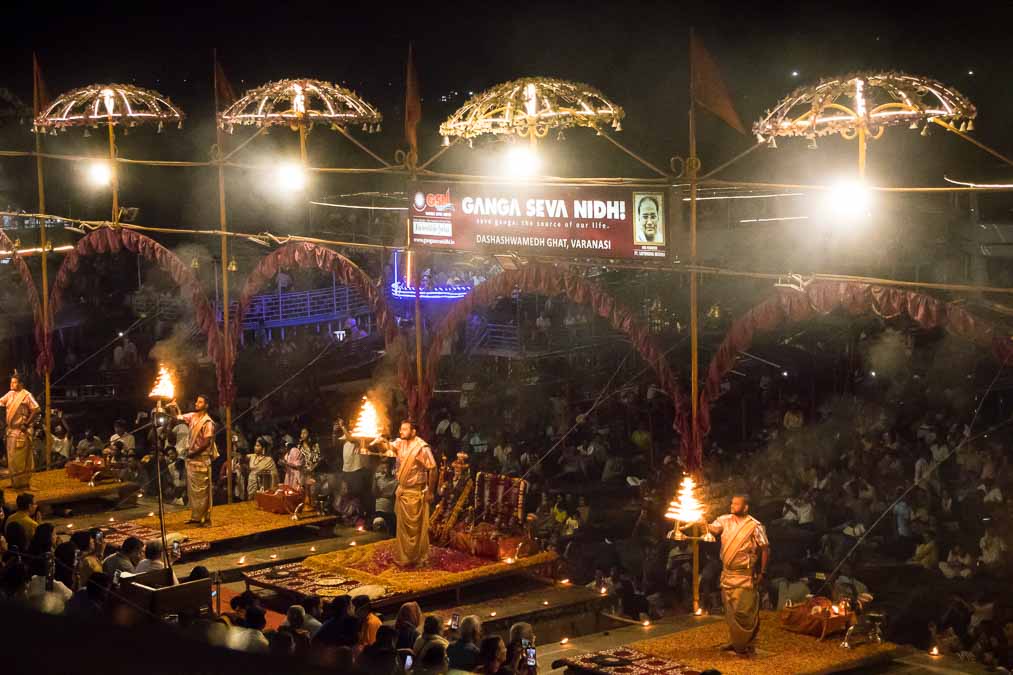
This all took place at the riverside where the stone steps, or ghats, lead down to the water. Another feature of the ghats are the areas set aside for open-air cremations. These happen throughout the day and night and are clearly visible to all – it’s quite shocking to witness.
Our hotel was by the river too and we came and went by boat so had close-up views of all this activity. Another great sight was the dancing couple who entertained us each night in the hotel. I can take or leave most hotels, but the Brijrama Palace Hotel was exceptional.
Other highlights of Varanasi were the back alleys and bazaars, plus a visit to a family silk weaving factory. Varanasi is famous for its silks, so I did allow myself to buy a small silk souvenir. Featuring animals, obviously.
Forts and Palaces
A seven hour train journey took us from Varanasi to Agra where we began our Golden Triangle tour of India’s iconic forts and palaces. First stop was the Itimad Ud Daula tomb also known as the Baby Taj Mahal as many of its featured were used in the building of its namesake.

We had our first view of the Taj Mahal from a distance; then walked around the UNESCO heritage site, the Red Fort. Built in the 16th century for the Mughal rulers, it’s a truly impressive structure. Next was the iconic Taj Mahal itself. Another Must See – especially if you combine it with a trip to see tigers.
With a stop to view Fatchpur Siki – more 16th Century Mughal magnificence – we then went to Jaipur. Here we explored the Amber Fort. The key design feature of this complex was how the Mughal Emperor Akbar Man Singh I ensured each of his 12 wives had their own private living space. He visited them each for one month each year.
The final stop in our Golden Triangle tour was Delhi. The highlight here was Qutb Minar with the tallest brick minaret in the world. Built in the 12th Century, there are lots of ruins to walk around.
LMost of these places are UNESCO World Heritage sights and they combine impressive structures with detailed artistic designs. As our guides often pointed out, even centuries ago Indian people had exceptional levels of both scientific and artistic skill. Whenever I heard this, I couldn’t help recalling, with a sense of profound embarrassment, that at primary school we were repeatedly told how we British ’discovered’ these countries and ‘civilised the local natives’. I trust that is not taught today!
And Lots of People

Seeing all these iconic places was fascinating. So was just being in India today. It has an energy and vibe that is so different to what I’m used to. We often stopped at bazaars to absorb the sights and smells of everything on sale. These colourful and crowded places were full of foods, fabrics and other artifacts. Much more fun than buying on-line.
Being on the street – whether on foot or in a car – was less relaxing. Little attention is paid to staying in lanes. As well as cars driving in all directions, there are tuk-tuks, motorbikes and cyclists scrambling for space. Plus, the odd herd of cows and group of goats wandering past. Horns sound from every angle, but not in an aggressive way. Even so, I would never have the courage to even attempt to drive in India.
Tiger, Tiger
The second half of the holiday was dedicated to wildlife watching – especially seeking out tigers. To maximise our chances, we went to three national parks, starting with Tadoba Andhari Tiger Reserve. This huge national park, based in the Chandrapur district of Maharashtra, has over 100 tigers which means visitors have a fairly a good chance of spotting one. Well, over 6 drives we had 12 viewings in total, of 8 different tigers! That was thanks to our guide, Ash, who went out of his way to grant my wish. I have seen many big cats, but tigers are something else. They utterly ooze majesty and power; and they were totally disinterested (perhaps just as well) in us humans. They are the true leaders – which prompted me to write a poem which you can see here: https://allisonhill.com/2026/06/13/tigers-v-trump-poem/
We were told that April is a good time to visit as it’s hot and the tigers can often be seen near water. May can be uncomfortably hot, so best avoided. Good advice. One day it was 43 degrees so we got a sense of what May would be like. Most of the tigers we saw were in water which made for some great photos.

Talking of photos, mobile phones are strictly forbidden in the parks. This is partly to stop people sharing GPS locations of the tigers and also because over-excited tourists taking endless selfies have caused disruption and potential safety risks. Regular cameras are fine, but I did miss having my phone camera as a back-up. It will be interesting to see if other wildlife locations adopt this rule.
While our attention was on tigers, we did see lots of other animals – and birds – at Tadoba. We got fairly close to some very relaxed sloth bears and were endlessly entertained by the langur monkeys. Tadoba certainly lived up to its reputation.
Our second park was Pench, which we stopped at for one night and one drive to break our journey before our final destination, Satpura. Pench is a popular park and understandably so. In one drive we saw our first leopards, wild boar and elephants, plus more langurs and lots of deer.

We had 4 nights and 3 whole days at Satpura so plenty of time to see this beautiful place, both from land and water. Our excellent guide George made sure we had lots of great sights: elephants, giant squirrels (a first!), leopards, a pack of wild dogs, and lots of langurs including a mum with baby.
We didn’t see tigers, mainly due to unlucky timing. A tigress frequently visited a particular spot, but she hadn’t been seen for a week – when she was clearly heavily pregnant. So, she was most likely denning with her new-borns. Seeing cubs would have been the ultimate experience – we were just a bit too soon. But I was so pleased with the tigers we did spot, plus everything else. Do add tigers in India to your must-see list. And the Taj Mahal.
Many Thanks
Many thanks to Will Field at Audley Travel who really did listen when I said the main purpose of the trip was seeing tigers, to Rubaina Mirza who was a real help on the ground dealing with some logistics; and, as I’ve mentioned, the truly excellent guides, Ash (at Tadoba) and George {at Satpura). And, of course, to my old (😊) friend, and travelling companion, Bernie, who patiently waits while I take yet more photos and who suggested the visit to Varanasi.
See More Photos
There are lots more photos on Instagram here: https://www.instagram.com/p/DZfJ7jADXid/?img_index=1 Starting with Varanasi, followed by photos of those iconic places, people and all the different animals we saw.